Tuesday, April 20, 2010

Storming the gates, or can't we all just get along

Let’s all storm the fences. I’m mad as hell and I just can’t take it anymore. The tyranny of the gatekeepers has stifled all creativity and I can’t find any innovative or creative films. A secret cabal of festival programmers, distributors, IndieWire editors, producers reps, broadcasters, Apple employees, NYTimes reporters and theater owners is holding back the flood of original, amazing content.

Ok, anyone who’s worked in this business for more than say, a year, will laugh hysterically at the cat-herding thought of corralling that many movie geeks towards doing anything other than watching cinema. They can’t agree on what’s good and what sucks, much less what to suppress and what is genius. They seem to all agree on avoiding sunlight, but beyond that, no such cabal of gatekeepers exists folks.

Alright, there’s some truth to the whole gate-keeper argument. There is someone (many someone’s, actually) who has to weed through those 3000+ submissions to Sundance, and someone else who has to weed through the accepted films to figure out which ones might find an audience in New York City, much less in Topeka. You can choose to call them gate-keepers, but I like to think of them as shit-strainers - a big industry protecting me from all the crap out there. These poor souls watch more than 500 films a year on average, only ten or twenty of which might be worth me ever seeing, and for all that thank-less work, all they get is a bunch of name-calling in the blog-o-spheres (I could link to ten articles in the last week that are somehow related to this, but you’ve probably read them already).

We should be giving them a medal.

Thursday, April 15, 2010

Possible attack on Attack of the Clones reviewer

Mike Stoklasa of Red Letter Media just recently released his new review of Star Wars Episode 2: Attack of the Clones. If you haven’t already seen his Phantom Menace review, you’re missing one of the best things to come out of the interweb pipes. Seriously, don’t click these links unless you are ready to spend a good three hours of your day watching both reviews back to back (each review consists of about 10 episodes of 10 minutes each). I’ve written about him before - how I truly think he’s single-handedly created one of the more innovative new art forms online; I hope it changes film criticism as we know it and I think watching it gives the average creative viewer about a hundred new ideas for and/or about story-telling, criticism and new directions for remix, mash-up, copyright and creative practice to name just a few things. But I’m not writing this to help you discover the latest viral video sensation - the web does that fine without my help - but to point out that we’re in danger of missing out on more of these genius pieces because of fear. As both TechDirt and MTV have mentioned in the past few days, Mike is terrified to death that Lucas will sue him (to death) and is contemplating an end to his creative practice.

As reported in the MTV interview:
"...not 48 hours after its initial posting Saturday night, the first segment of the review was taken down by the popular video sharing service, "ostensibly" after a copyright claim by Cartoon Network.
"Was it really Cartoon Network or not? I don't know," Stoklasa sighed. "There was someone who started a rumor that it was a specific YouTube user who had copied the first part over to his channel and then put a link to his Web site in the description. But YouTube doesn't tell you who flagged it."

He goes on to say:

“The thing is, I'm no lawyer. But I had someone actually talk to a copyright lawyer, and they didn't know what to make of the reviews. It's a new thing, You can get away with using a clip from a movie for the purpose of review or commentary, but can you dissect an entire film like that? There's commentary and it's part satire [because of the character, Mr. Plinkett] and part review and part educational as well because there's elements of filmmaking insights."

This is how our copyright system works against creativity - because the rules aren’t always clear and fair use can only be defended if sued, the mere fear of a lawsuit stops people from innovating. Now, I think he has a clearly winnable case, and it’s far from clear that he’s received even the slightest legitimate threat of a suit, but the point is - this is clearly creative work that should be encouraged, not stopped (I can see why Lucas might not like it, but that’s tough luck, kid). Pat Aufderheide and Peter Jaszi have done some great work clarifying fair use, as has Michael Donaldson and many others. I’m sure if needed, some team that includes them and probably the Electronic Frontier Foundation (EFF) can step up to his defense - and they will likely win. In the comments section to the TechDirt post, Nina Paley weighed in saying we should start a legal defense fund to support Red Letter Films if he is sued. So I, like Nina the filmmaker and Mike Masnick the writer am just chiming in to say - yo, Stoklasa - keep making review films, don’t worry about lawsuits - if they come, I’ll join the Kickstarter campaign to fund your defense. A few other things - yo, filmmakers and critics - follow his lead and make more creative reviews like this - a flood of them might help  - a tsunami of remix reviews is a hard thing to stop. Yo- film festivals - program his reviews in their entirety as midnight screenings. The audience reaction will likely be amazing - and it will prove you can program something that's available completely for free everywhere, and still make money!

Here's part one of the new review:

Tuesday, April 13, 2010

My advice to the new DocNYC Fest

The best news of the last couple of weeks was the launch of the new documentary film festival in NYC - DOC NYC. The child of Thom Powers, Raphaela Neihausen, John Vanco and Harris Dew, this festival promises to be a great new addition to the fest scene. This isn't news - Indiewire and thousands of others reported it, but I received an email invite to give feedback on the festival at a meeting this week, and because I’m in Orlando on the Shorts jury for the Florida Film Festival, I'll miss the opportunity. The founders asked for feedback anyway, and while I think they meant privately via email, I figure it can't hurt to tell everyone what I think - because it's all positive and because it’s really advice for all film festivals.

First - congrats to the team - you've assembled a great group, have central locations and an amazing board/advisory board. The overall response seems positive and the goals of the organization look great. While I am the first to say the last thing the world needs is another film festival, we do need a good showcase of documentaries in NYC - something devoted just to the form, unlike the other (great) fests in town. I also really like that you are saying it won’t just be film, but also other formats, which is great. So, here’s my thoughts on the fest and what I think you need to do to have great success and impact on the field.

Premieres - In your press release and in the early articles on the festival you mention that not every film in competition must be a premiere - stay true to your word. The very last thing we need is any new fest demanding premieres. This will be tough - mainly with the press - who are probably more responsible for premiere-itis than any single group - but it’s always tempting to let premiere status decide what gets in when you have a lot of good things to choose from. Film A is a premiere, Film B isn’t....so you program Film A. Don’t fall into this trap. Furthermore, be prepared to go an extra step - be willing to show a film even if it played somewhere else in NYC already. I know, this one is tough to swallow, but I promise you, if it’s a good film and there’s a good conversation around it, you’ll sell it out.

Thursday, April 08, 2010

Ken Price, Bukowski, Curation and Film

This post is a little off-topic, but I think it ultimately relates to film - in terms of curation and one idea that might work for some films. Over the past few weeks, I've been enjoying what is probably one of the best curated shows in New York right now - Josef Albers/Ken Price. The main show is at Brooke Alexander in SoHo, Manhattan, and it arguably gets the curation award (photo at left is from their site). In short, the curator Brooke Alexander once heard that the only piece of art that Ken Price kept in his home was a piece by Josef Albers. This led to a wonderful pairing of the works of the two at his gallery and in a stroke of genius, he was able to convince 4 other galleries to display additional works by either Price or Albers at the same time. The pairing is incredible and allows you to think about each artist, their work and art history in ways you hadn't expected before. Roberta Smith, writing in the NYTimes, said of the show "As far as I’m concerned this superb show could be maintained in perpetuity, courtesy of the Dia Art Foundation or some such. It should be required viewing for anyone hailing from the fraught curatorial profession (and its over soon, so catch it now). Its overarching theme is that abstraction is reality-based, distilled from lived experience, and actualized through highly personal approaches to process and materials. It’s a lesson in life as much as art." I think it should be required viewing for any curator, not just fine art curators, and that includes film programmers and curators as well.

Tuesday, April 06, 2010

The trifecta that broke the internet as we know it

That deafening applause you hear is not from Durham, NC post NCAA, but rather from the MPAA and the representatives of other major content providers on both sides of the Atlantic cheering on what may be looked back upon as the trifecta week that broke the internet as we know it. Three momentous things took place simultaneously this week that combined are more important than most people realize - the Ipad was released, the UK looks poised to pass Debill and a federal appeals court ruled that the FCC doesn’t have the right to regulate broadband, thus possibly ending its ability to enforce network neutrality.

Nail number one. Lots of people went and got themselves an Ipad yesterday, and many in the film industry are debating whether this is a good thing or a bad thing for independent creatives. Big media is rejoicing, as they think this will be their savior - allowing them to put the genie in the bottle and start selling their content to huge profits again. Old world computer geeks can’t seem to stand the closed, one-way nature of the Ipad (consumption), but their grandma’s seem to love it. Indie lovers think that wow, now they can make an application and actually make money for their content, or get their films seen by more people on the Netflix API. I have serious doubts that indies will be served well by these developments. Sure, a lucky few will make cool applications off the API to serve up and charge for their content, but most of us will be stuck where we’ve always been  - begging some gatekeeper to get our content onto the most used platforms. More importantly, this is a consumption machine - no USB drive, so you can’t even bring in your own content easily, no camera in front, sanction needed from on-high in Apple HQ, yadda yadda. My personal hope - this is like AOL in the early days. Everyone will flock to the ease of use of the walled garden for awhile and then realize they can do much more outside of it. That’s probably a best-case scenario, because this thing is popular and it’s hard to convince a public looking at something cool that there could be something even cooler than what they have. I can’t blame them, and we’ll see if perhaps this becomes the consumption machine for those things created on laptops, etc., including those creations of independents. In the meantime, the main reason I’m not playing with one is less philosophical - price.

Saturday, April 03, 2010

DIY Days - Reinventing Innovation Speech

I just wrapped my DIY Days speech (ok, hrs ago) and people have asked for the text and slides. So here they are. I am kinda commenting on the slides, and some slides are counter-points to what I am saying so the video will  be much easier to follow, once it is up.
Slides:

Here's the text, after the fold:

Friday, April 02, 2010

FFF - What we can learn from social issue docs

All this doom and gloom in the film business is getting to me...

Nah, just kidding. I actually think that all of my posts lately have been pretty upbeat, even though some people have said otherwise - the underlying message is to figure out ways to make the film business work better. I also don’t hear as much negativity out there in the media business as I used to, in fact, most of that talk is getting pretty old and stale. When I meet with serious filmmakers, and by this I mean whether emerging or established, they have their heads on their shoulders and know the various games you have to play to make films and get them seen, they are pretty upbeat. They are generally excited about all of the changes, they can’t wait to experiment more and they can now at least try around with some new ideas since the old ones didn’t work well for many of them. Okay, quick aside, I do still meet serious filmmakers who are depressed, but I’ve posted enough about them for now and this is a happy post. So I’m now initiating a new category of post here, one devoted to nothing but the good news, the things that are working amazingly f-in well, things I love about film or the film world today or people I want to champion. I hope to keep up the good spirits at least once a week, but given my general grouchiness, and how many projects that pay me are on my plate that week, it may slip (unless I find some happy guest-bloggers, hint hint). I need a name for this feature, but I’m going to try and crowd-source that work - suggest away in the comments or via DM or email. For now, in the spirit of Twitter’s Follow Friday or #FF, I’ll call it FFF for Fun F***in Friday, which also let’s me celebrate cursing, my favorite hobby after film.

This week’s FFF - social issue documentary film. Yes, this sector is not usually associated with fun, but if you’re raising money, looking for help, looking for partners and strategies, looking for a community, building an audience, searching for new strategies, thinking about how curation helps content at festivals or pretty much any other activity in film, this is the Fun sector for you! I’m not kidding. The doc sector in general, but especially the social issue doc sector is thriving, has built some semblance of an infrastructure and is connecting with audiences, which isn’t easy for tough subject matter. It’s doing so well, in fact, that lots of filmmakers get upset that unless they are making a social issue doc there’s no chance for grant support, etc. But this is FFF, no complaining allowed - instead, we should look at what they are doing right and try to replicate some of it in the rest of the film world. So what water are they drinking? Well, someone who actually works in it daily can probably chime in with more than this list, but here’s a start (not in order of importance, just the order in which I think of them):

Wednesday, March 31, 2010

Who’s not wearing swim trunks, or: Film is a bad business


You can spend a lot of time online and off keeping up with all the changes being wrought by all things digital. You know, it has pretty much ruined the business models for print, music and now film and all that (I’m going to refer to digital as an it for the sake of this post). It’s also been responsible for new production methods, new distribution methods and is likely changing a bit about how we can tell stories. That’s cool and all (or horrific, depending on your vantage point), but to me the single biggest effect of digital has been the transparency it has brought to everything. Warren Buffett has said, regarding the economic collapse, that one doesn’t see who’s really wearing the swim trunks until the tide goes out.

Well folks, digital has behaved like the Moon and brought out the tide in the film world and we can now see that pretty much the entire business is naked as a jaybird. More importantly, however, it always has been this way, especially for indies. As a noted filmmaker once said to me in regards to all of this - well, yes, it’s always been rape and pillage, but now it’s much more apparent.

Monday, March 29, 2010

Selling your film - when is the best time?

The Conversation took place this week in NYC, and while the entire event was great (kudos to the organizers) and I learned a bit, had some great conversations and even found some inspiration, I was also left scratching my head. How can we, as a field, get something so collectively wrong as the notion of film festival premieres and audience awareness? Thomas Woodrow, a producer who I admire, stated on one panel that you needed to sell your film at the point of its maximal awareness, and that for Bass Ackwards, that was clearly at Sundance (paraphrasing). Joe Swanberg said something to this effect regarding his decision to do a simultaneous premiere at SXSW and on IFC. We’ve seen these experiments at multiple festivals now, and will continue to see more. As currently conceived, all of them will fail.

Let me be clear - I am not critiquing IFC, the filmmakers or the festivals for experimenting - we need more of that. I also like all of them. I’m also sure that some of them would argue with me over what constitutes a failure, and I’m sure some of them will make some money, possibly even good money. That said, we’ll never know how much they might have made with a different strategy. My argument here is really with the notion that a premiere at a major festival is your point of maximal awareness. It’s not, never has been and never will be, unless such festivals do a lot of re-visioning of what they are and how they operate.

Thursday, March 25, 2010

My conversation(s) at the Conversation

This weekend, I’ll be speaking on a panel at The Conversation, a great event that has apparently sold out. My panel is about new ways of thinking about film festivals, screenings and DVD. The panelists joining me are great - Robert Bahar, Ira DeutchmanBob Hawk and Mitch Teplitsky, and we’ve been emailing and hope to offer some good thoughts on new ways to make all of these work together for greater exposure, impact and hopefully, revenues. I’ll also be moderating a session where four social media experts talk a bit about new trends and then workshop audience member’s projects. I’m looking forward to that, as I think panels should, like culture today, become more participatory.

During lunch, I’ll be hosting a discussion on best practices for building robust audience engagement. What does that mean? This is the brief description I offered the organizer, when planning the talk:

Building robust audience engagement - Everyone is (finally) talking about audience engagement, but how can we enable more robust audience engagement? What happens when we think about engaging audience from the script stage, or allow them to interact at the story level? This discussion will focus on best practices and new ideas for building deep audience engagement.


I’ve been getting frustrated lately that most of our talk, mine included, around engagement has been in limited ways - crowd-funding, audience building (followers/fans) and at times, getting active with some issue in the film, usually if it’s a doc. Some transmedia types go further and try to engage the audience in the story in multiple different ways. Good transmedia types are even doing this from the beginning and letting the audience interact with the story, and maybe even change it. As filmmakers begin (ok, I know a few who’ve been doing this for a long time) to think more about audience engagement, they’ll need to think about this as well. What happens when you let the audience have more control? I’ve spoken to many filmmaker who are horrified at this thought - they want to be the auteur and maintain all artistic control. Sure enough, there’s also good reason to wonder about the aesthetic quality of such projects. There’s also, however, much potentially to be gained. New things might happen that we don’t expect, new story forms might be developed and something creative might take place. It will also likely increase audience engagement and perhaps that in itself will build larger audiences. I’m not sure what will happen, but I’m interested in discussing it, and if you are too, then join me at lunch.

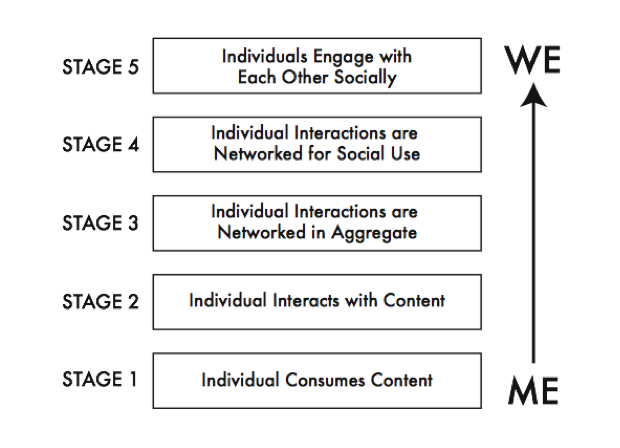
A second part of the conversation is much more basic. If we want to engage audiences more with our projects, what might be some best practices. I’ve been reading a bit of Nina Simon’s book, Participatory Museums (you can read it online free) and she does a great job of analyzing what attributes help make something more participatory. In chapter one, for example, she lays out different types of participants, from those who don’t at all, to the most active ones and gives real world examples of ways to get people to move from “me to we,” or to become more actively engaged with a project. (You can read about it here, I’ll probably blog more in-depth about it later, and that chart above is from her site) I’m hoping to discuss how her ideas about participation in museums might work in thinking about films and storytelling. I’d also just like to hear about successful examples from others at the conference. So, if any of these subjects interest you....join us.

Thursday, March 18, 2010

My presentation for BAFTA Scotland

Here's the Slides from my recent presentation in Glasgow, Scotland for Scottish Students on Screen, a program of BAFTA Scotland. For those of you who've seen my other presentations, this one won't be really new - it combines a few things from multiple different presentations, but it does add a few new things near the end. I always post these, however, so that people don't have to take notes on links, etc which are all embedded in the presentation. The entire day was great, with many other good speeches, including one from Anita Ondine and from Peter Mullan.


Sunday, March 14, 2010

Re-thinking impact in film


I recently attended a think-tank, strategy session for an independent documentary filmmaker trying to have meaningful impact with his film. He did a smart thing - gathering about 30 really smart people (plus me, somehow) to talk about having an impact with film. This got me thinking about this question generally, and while this filmmaker was coming from the right place on this, I generally have a problem with this whole question. I have been thinking about this sense, and it led me back to a post I made on this blog in 2006. There might be one or two of you who read me now, but I figured most of my readers are new (the rest having left from all these long posts), and I think this post is still pretty relevant.  Plus, I've been busy this month and posting less, so this gives me something new/old. So, with some minor revisions, here’s some thoughts on the whole question of having an impact with film.

Increasingly, the foundation community and other funders of film are asking the question, how can we have more impact with film? Quite often they are focused only on social media, and the implications are twofold: first, that past efforts to have impact through film have not succeeded, and second, that impact means more than eyeballs – in other words, that audience size isn’t enough and that some larger change also must take place. Let us realize from the outset that the first assumption is completely false. The second assumption puts forth a proposition destined for failure, and one that is based on a fundamental misunderstanding of the relation of media to culture, the civic sphere and social change. That said, as many filmmakers and media organizations rely on support from those obsessed with impact, we must address this concern now, for although grounded in many false assumptions, the premise is ultimately true.

Thursday, March 04, 2010

Building a community through Remix

I've talked about these folks from Spain before and in a few of my presentations, and now Riot Cinema is up to more good shenanigans, partnering with The Auteur's Garage, for a pretty cool remix contest.


You can head over to the site, grab their content, remix it however you'd like and upload your new version of a teaser trailer for their upcoming film, The Cosmonaut. They've put up over 30 clips (including clips they've yet to use), CGI sound, voice-over files in Russian and English and just about everything else you need. There's a contest that promises to have lots of cool prizes and in case you doubt these kids are moving to Billyburg soon, they've even got a Cosmonaut branded Lomo camera as part of the mix.

These folks are doing some really cool stuff for their film. They're convinced that by opening up the entire process and letting their fans become participants, they can build an audience for their film before they've finished shooting it. They don't yet live in Brooklyn, but rather Spain, and trust me on this - not many people in the European film industry are rushing to embrace new models, so it's exciting to see them so enthusiastically trying new things. I hope it works for them, and it seems to be doing so already.

For my money, however, the coolest thing they are doing is their fundraising campaign in general. They're doing a whole crowd-funding thing with lots of great merchandise for sale. My favorite are their pencils. The website text describing them is classic, but since it's in flash or something, I can't copy it here (note to the cosmonauts, there is one tiny fix to be made), so you'll have to click through for the hilarious story of technological innovation through NASA spending that they've posted.

I have no idea whether this film will be good or not, but I can guarantee that the cosmon-auters will continue to provide the film world with some great experiments and good ideas for at leas the next several months. That at least gives them some better than average chances of success with their film. I'm a big fan already of their fundraising video, which takes a cue from both Bob Dylan, ok Pennebaker really, and Four Eyed Monsters in strategy. I'm even happier that they've now posted this short, making of video of their trailer. Another smart move. Check it:


Making of Rodaje video Premios INVI from Riot Cinema on Vimeo.

Wednesday, March 03, 2010

MLK and Media?


Last night I joined the first NYC Transmedia Meet-up. Sounds horrible, right, WTF is that? It was actually a great little gathering of several people interested in where things are at and going next in film, media and transmedia, or cross-platform (please another word soon) projects (the book on the right is a good place to start learning about this stuff, BTW). While my mental state only allows for a brief visit to such settings before I really want to talk about something else, I had a great conversation with a small group about the difference between transmedia as marketing and as real transmedia. Lot’s to unpack in another post, but I really enjoyed some comments by Jeffrey Lee Simons, who has been doing this a lot, and you can read his thoughts on his blog. At one point he compared good transmedia as similar to Dr. Martin Luther King, Jr. Having had a couple beers, I was ready to pounce on this nonsense, but he might be right.

Among the many great aspects of Dr. King’s legacy was the fact that he empowered his audience. He wasn’t just a preacher, just a civil-rights leader, just a political figure, just an organizer. He was all of those things and more, but he had an uncanny ability to catch the mood of a certain moment and a lot of people and give them a message that didn’t just preach to them or tell them what to do - it empowered them to feel part of a movement, to know they could control their destiny and that their actions were as important as his. You never felt talked down to, or that he was the most important man in the room - you were on a journey with him, and yes he was very important to the movement, but so were you. When he said “I have a dream” it was powerful, for among many reasons, because that dream could become yours and you could add to it and make it happen.

This is simplifying Dr. King’s legacy a bit, but I think it’s a valuable lesson for anyone thinking about transmedia, and actually for anyone making a film generally, be it narrative or (but especially) a documentary. Let’s just call all of you media artists for now. What media artists often do is try to be the master of their story world, and exercise complete control over where it takes you. They tell you a story and it can enthrall, entertain or so many other things, but while it may “suck you in” it rarely empowers you and makes you feel you are as important to the story as the media artist who authored it.  Of course there are exceptions, but this is a generally true point for much media. Jeff’s point, I think (but it’s definitely mine), was that good transmedia goes an extra step. Yes, it gives you multiple story access points and good ones can be quite interactive, but to rise to truly great it must empower the audience. It too should capture the zeitgeist and bring you in to a journey for which you are equally important to the outcome. It should empower you to take action, to join the conversation and contribute to its fruition. Not by telling you exactly what action to take, necessarily, but empowering you to make a choice that could change the (hi)story. The nature of the story, by definition, must change based on how where you, the audience, takes it. Many transmedia experiences today are simply marketing. While they are on multiple platforms, they aren’t doing much more than giving you alternate ways to get to their story and (with some exceptions) they don’t empower you to add to or change the story. I’m not arguing that no one does this, but rather that more should think about this empowerment aspect.

While this clearly applies to transmedia, it also applies to traditional filmmaking. In documentary, in particular, I find a lot of films that tell me some story. It might be compelling, it might be persuasive, attempting to change my mind or enlighten it. They might also tell me where to donate, when to cry, or how to take some action. But rarely do I feel empowered in quite this same way. While I wouldn’t argue that every film should be an exercise in empowerment, I do think it should be explored by more filmmakers, especially those hoping to have a true impact. Plus, I can’t see any harm in trying to put a little MLK in your media making!

Friday, February 26, 2010

11/04/08 and participatory filmmaking

On 11/04/08 I voted, went to work and celebrated a bit too much at the end of the night when Obama took the stage to announce he'd won. Jeff Deutchman and more than 20 other filmmakers documented the entire day, from 8am til 4am the next morning, and the resulting film, called 11/4/08, is about to premiere at SXSW very soon. I was lucky enough to be among a small group invited to see the film in advance yesterday, and I can highly recommend you see it there or at another festival or screening soon. But this isn't a review post, but rather is a note that what Jeff is doing goes well beyond just telling a story of which we know the ending.

Jeff's idea came to him just a few weeks before the election. It was likely to be an historic moment, which it became as Obama became the first black president. It also turned out to be historic for other reasons - the turn out from young people, the places that turned blue, etc. But as many of us can remember, this wasn't a given, so Jeff's team could have ended up documenting the defeated hopes of so many supporters for all they knew. Jeff wanted to catch the day regardless of the outcome, and he asked friends from around the world to document their experience of the day, send it to him and he would "curate" a film from their footage.

More than 20 people, from accomplished indie filmmakers to amateurs, agreed to take part. Some filmed their own experience throughout the day, others captured organizers pulling out the vote, some went with the major crowds others just their own families and friends. Jeff calls the film a piece of "consensual cinema," and while you see the vision of multiple filmmakers shining through, it has been edited to his own rhythm. BTW, it interestingly let's you experience your own version as well, in a way, but that's for a review piece.

Jeff isn't done, however, with his participatory cinematic experience. He's still collecting stories online at the project website, and he's encouraging people to upload their footage, or their complete films, and to take the film's footage, remix it and upload their own versions for everyone to see. It's a great way to collectively re-participate in the experience. This is something that might make McCain supporters gag, but hey, they can theoretically spin their version as well, and I am willing to bet one of the more interesting results will be when that happens.

Anyone who reads this blog knows what a big fan I am of those who embrace the new, participatory culture and this film is an interesting way to use it for the recording and re-telling of history. Check it out when you can and spread the word. Oh yeah, as you can see from the image, there's a Kickstarter campaign you can help with too.

Tuesday, February 23, 2010

Engage 101 at Shooting People/DCTV

Tonight I gave a speech for Shooting People and DCTV called Engage 101 - Audience Building Masterclass. That was an impossible enough task, so I tried to make it harder and give a brief overview on film distribution, all the new models out there and some basics on using the web and some old fashioned tools to build your audience...all the way up to transmedia 101. Whew, not sure that was smart, but I got good feedback and it was fun. I also learned a lot from the questions, and at the end we opened it up for a group session on a few films, and as expected, the audience feedback was great. I always upload my presentations for free, so here below it is. No audio or video was taken, and these slides don't capture everything I said, but the essence is there. If you're super advanced in this stuff, it might not be worth your time, but could be worth a view for some new (and old) ideas. Feedback appreciated as always. This was also just one of many panels and masterclasses these folks do, with many great speakers, so check out their info online.

here's the presentation, and my apologies that Slideshare always repeats the title, the title, the title....I don't understand this glitch.

Friday, February 19, 2010

Ben and Noah in Rwanda

About a year ago I was lucky to join a group of people on a trip to Rwanda. With us on that journey was Joe Summerhayes and his two sons, Noah and Ben. They had the task of teaching several young students from Rwanda to make a hand-made animation about gorillas in just two days. Somehow, they did this, but it took them about a year to edit their mini-doc about our trip. It's a great little ten minute video, and I think it's worth watching all the way through, but if you feel 10 minutes is too long in this day/age, skip through to watch our amazing hike with the gorillas (and the near-death experience when a gorilla tackle's our leader!) and the preview of the animation they created. I only show up briefly, so you can tell what an impact I've had on these kids and their future careers in media! Great video, and btw, their father's blog is pretty cool too.

Wednesday, February 17, 2010

ACTA...wasthat? and why it matters

Well, the New York Times finally covered what is arguably the most important tech/film/net/future/etc story going on in the world (a close second to the Google/Authors Guild proposed rip-off) yet I'm not seeing much about it in the blogs and tweets I follow from the film world. That's bad news, because this is something every filmmaker should be aware of, as well as anyone who is interested in the future of content online. Or the future of the net, really, and that should be everyone. So what the heck is ACTA and what can you do about it?

I know, I know, these policy things make your head hurt. Mine does too, and this one is a doozy. ACTA, or the Anti-counterfeiting Trade Agreement. Haven't heard of it? That's because you aren't supposed to know about it. It's a top secret negotiation between major countries to combat counterfeiting. You're probably thinking well, piracy and counterfeiting are bad, so what? Well, there's lots of arguments against that view, but even with it, it's a pretty big concern when major countries meet in secret, with no democratic input, about possible rules which could forever change how we access content online. Guess what....your needs as a little indie producer/consumer probably aren't on the list. But you can bet those of the MPAA are, and knowing how like the RIAA they've become, you can bet their proposals amount to breaking the net to preserving their business model.

These talks are secret, you know, like the ones you kept when you were twelve, so details are scant, but there's been leaks and they've have included some doozies.

Wednesday, February 10, 2010

Upcoming panels and workshops

I've been here in London, doing some consulting and speaking at Shooting People's "Short-sighted" event at BAFTA. It was a great conference and I highly recommend that filmmakers check out the line-up of speakers and (eventually to be posted) the videos of the day. They gave out many resources for indie filmmakers, especially short filmmakers, and I learned a lot. More soon, but there was a fascinating discussion about advertisers/sponsors and indie films, inspired by a dialogue with MoFilm. They've got an interesting model for short filmmakers working with brands. Check out their page for some details on how they work, and the contests they are running. Many filmmakers have benefited from the program, but some in the audience took issue with the corporatization of indie filmmaking, as well as their deal structure and payments. I'll have more thoughts on this soon, but for now a note to festival and conference producers - this is the conversation to be having going forward and it's much more interesting than new distribution yadda yadda stuff. The biggest change to indie will be how we work with advertisers, sponsorships and corporate support for media (or don't). Especially in Europe as state subsidies dry up and corporate support becomes one of the only viable options. What are the ethics, the best practices, horror-stories, etc. What do we think about this as indie filmmakers and what is our stance? More soon....

I'm very excited to be speaking soon at several cool events. Check out the following websites, not just to see me speak, but because the other speakers are pretty great and there's bound to be some great conversations. I look forward to learning more about the future of the business at each of them:

First up on March 27th is "The Conversation." Scott Kirsner has been running this excellent event in a few cities for a couple years now and I'm excited to be part of the line-up in NYC. Check out the schedule and sign-up soon.

The following week on April 3rd is "DIY Days NYC." Lance Weiler is putting together an excellent group of speakers, and what I like about this is that he's looking at innovation beyond just film - in music and other arts as well. This one is free, so consider this and the Conversation and it's like a 2fer1 special!

Later this Summer I'll be participating in a new Lab from Power to the Pixel - a full week of intensive training and discussion around trnasmedia and the future of the business. As the organizers explain -
"The Pixel Lab, a ground-breaking new residential course centred in developing, producing and distributing cross-media stories – stories that can span film, TV, online, mobile, gaming. The Lab is open to anyone with a strong track record in the European film and related media industries."

You have to apply soon, so check the website asap. And, if you need a cool job, they are hiring a producer for the event, so look into that as well.

I'm booking some other talks and projects soon and hope to report more in the coming weeks.

Tuesday, February 02, 2010

On the YouTube, Sundance Failure

Share photos on twitter with Twitpic There's been a lot of noise out there about the YouTube rental program and it's experiment with some films from Sundance. Most of the posts seem to (almost gleefully) agree that the program was a failure - and with approximately $10,000 in net revenue, it's hard to disagree. So, I'll concede from the start that whatever this experiment was, it was a failure. I don't think it's something we can really make any judgements from, however, as it was almost not even an experiment. The story of this debacle really shines a light on the problems Sundance has always had with digital, and which YouTube seems to have with monetization in general, but I'm not sure it shines any light on indies, rental or the future of the business except that it might not be Sundance and YouTube figuring it out (even if they likely remain part of the answer).

First, calling this an experiment in day/date rentals is generous at best. Ok, they did get lots of press impressions, but in nearly every mainstream publication I read, the story was buried on about page 2 of the business section. Almost every story focused on the idea of rentals, the fact that it was in partnership with Sundance or some similar angle. There was almost no mention of the films, the merit of the films (as no PR person seemed to think that was something to pitch them on) or anything else that would make you want to see the films. Then we have the marketing...or should I say we didn't.

Midway through this experiment my Sundance condo-mates and I did our own experiment - how easy would it be to find and rent a film. So late at night (disclaimer, we'd been to a party or two, so this could be an influence) Lance Weiler, Scilla Andreen and I tried to find the films online.

For an hour. With no success.

Monday, February 01, 2010

Diverse thinkers on the new era

I’ve been spending much of the last few years on the road speaking at numerous panels about new models for film, new media and distribution. I’m continually peeved to find myself sitting on a stage with a bunch of other white guys talking about the future. Usually, there’s not even a woman on the panel. I often bring this lack of diversity up publicly, because I find it so odd to find a bunch of white guys talking about the future - when we are decidedly not the future. What gives?

I found myself thinking about this again at Sundance in the panel entitled “The Doctor’s in the House” on distribution. Besides the moderator, Eugene Hernandez, there was no diversity on the panel. Now, I’m not faulting Sundance here - while their track record isn’t great when it comes to diversity, they aren’t the only, just the most recent example of this phenomenon. It’s much broader.

During the panel, I tweeted out the following:

“What, do only white people think about new models for film?? Wtf #sundance c'mon”

Thursday, January 28, 2010

Slamdance and Sabi Pictures on the future

Just back from Slamdance, and Sundance, where I participated in a great event called the Filmmaker Summit. My particular panel was about the future of film festivals, and I hope to put forth some thoughts on that soon. In fact, the whole day made me think a lot about the future, but that's for a later post. What impressed me the most about the event was that the organizers tried hard to include the audience and other filmmakers in the design for the event, in the event discussion and hope to do so going forward. They started a discussion page in advance for input. Each panel met in advance for a great talk about their subject - mine lasted an hour and a half (of prep, mind you, for a 30 minute panel) - to be sure we could jump right into discussion. They're gathering further comments online now, and I hope the discussion continues.

What most impressed me, however, was that they decided to get two filmmakers - Sabi Pictures (Zak Forsman and Kevin Shah) - to post a series of videos related to the festival, exploring the questions and themes a bit more. The videos are executive produced and sponsored by Workbook Project and Filmmaker Magazine, and the entire event was sponsored by IndieFlix, the Open Video Alliance and Slamdance (amongst others). Sabi didn't just tape the talks, edit a piece and throw it up for viewing. Instead they are exploring the questions from their position as filmmakers in the middle of making and then distributing a film. They went beyond the Slamdance Filmmaker Summit and interviewed other people, including (gasp) Sundance filmmakers to try and work towards some new answers. They aren't done yet, but the first few videos are online. They feature yours truly in the first few so far, so yes, I am self-promoting, but I think the best stuff comes from the filmmakers they speak with and their personal voice in the films. Check them out online, and give me your thoughts. I'll have more on the Summit and the entire week soon.

Videos after the fold:

Tuesday, January 19, 2010

10 ideas on the future of the arts (20<40)


My recent post about possible leaders in the arts under 40 (20<40) ended up getting some traction. The idea it was based on wasn't mine, but rather comes from an upcoming book on 20 new ideas by emerging leaders in the arts who are all under 40. I've been selected to submit a chapter, and hope to do so soon. The idea of the book isn't to discuss who are the leaders, but to listen to their ideas about the future of the field.  In the spirit of openness, I submit my idea below for your feedback and advice. The chapter I am contemplating writing (and I have to do it soon) is about some key changes in the arts. Not the most cutting edge changes, mind you, but those that I think will have the most impact in the next few years. These ideas will be old-hat to anyone who thinks about these matters a lot, but I think they bring together some of the more important changes we face in the arts in general - and of course to film, particularly as that's where I work. So, tell me what you agree with, disagree with, think is more important, etc. I promise that I'll consider all responses before submitting my final chapter. So here's what I think:

Slamdance Jury & Summit


I'm excited to be heading to Park City this year, and now I can say why - because I'm on the jury for Slamdance. This year I'll be one of the judges for documentaries, and the line-up looks great. The rest of the jury line-up should be public soon. I'm looking forward to meeting the filmmakers there, and also participating in the Filmmaker Summit, which I wrote up earlier. There's a lot of great things going on in Park City in addition to Slamdance:

This little old fest called Sundance.
....Which has a great panel on rethinking distribution
....And a cool New Frontier Section.
The Filmmaker Summit
Peter Broderick's Distribution Clinic.

So, if you are headed to Park City, I hope to see you there. Let me know of other good things going on in Park City, and good luck to all the filmmakers.

Friday, January 15, 2010

My 20<40 leaders in Film

Well, that went over well....No one has suggested anyone for the twenty leaders under 40. Considering I made it clear that you could even nominate people over 40, I’m surprised. Perhaps no one cares, or perhaps as was suggested to me, people don’t want to diss anyone by not nominating them. One person suggested online that they couldn’t think of any real film leaders under 40. Before giving up on this experiment, here’s my list of 20 leaders in film under the age of 40. I’m not sure all of them are actually under 40, but they all look young. And these aren’t my only picks, actually, so if you aren’t on the list, don’t feel slighted. In picking my starter list, I tried to stay away from some of the usual suspects - i.e., if I speak on panels with you on a regular basis,  or everyone refers to you as our savior daily, I left you off the list. The people below are leaders in the film world who I deeply respect and who I think will do at least one thing, if not more, to improve the indie film world in the next five years. Disagree? Don’t say so here. No need to denigrate anyone, but do feel free to add people you think I’ve missed. I’m sure there are lots more.
This list is in alpha order by last name:

Wednesday, January 13, 2010

Who are the 20 < 40 in film?


I tend to spend my days between a mix of the film world and the art world. Not that film isn’t an art, but meaning that lots of thinking in the capital A, Arts World doesn’t filter to the Film World and vice versa. In the arts world, there’s a cool project going on now that I think would be worth repeating in the film world - it’s called 20Under40. The aim of this project is to gather 20 emerging (or even established) leaders in the arts who are under the age of 40 and compile their thoughts about the future of the arts in one anthology. Or, in their own words:

In light of the impending generational shift in leadership the field of the arts and arts education is about to experience, there has been much talk about the future: who will be our new leading arts thinkers, administrators, policymakers, and practitioners—and in what social, cultural, and political landscapes will these individuals operate? While there is great concern surrounding this matter, little is being done to provide a platform for tomorrow’s leaders to share their ideas with the larger field.

20UNDER40 endeavors to collect twenty essays about the future of the arts and arts education, each written by an emerging leader under the age of forty. In doing so, this anthology will provide a unique arena for new ideas by formally gathering the thoughts of young artists, teaching artists, administrators, researchers, and other arts and arts education professionals—legitimizing the talent of young leaders by bringing their ideas out of the margins and into the forefront of our dialogue.


I submitted a proposal which made it to the next round of selection. Now I have to turn in my chapter and make it to round two, which I have to admit - I hate. I mean, come on, I’m writing for free and don’t know if it will even be published, what is this....Hollywood? Regardless, I’m going to submit my ideas, and I’ll be posting more about my thoughts soon for your feedback, but this isn’t why I’m writing now. Instead, I want to know...You guessed it...

Who are the 20 leaders in film under 40? Who do you think will lead change? Should we  have a similar project in the film world? Perhaps where film leaders under 40 submit proposals for some website publication (Workbook project??) or a book? Perhaps we should start the <40AKC - the under 40 ass-kickers club, a monthly mixer for these folks? I think all of these could be interesting, but would love your thoughts. In the meantime, who are the 20under40 people we should be following in the film world? Feel free to nominate yourself, and bonus points if you name people that aren’t on the usual suspects list. Who is that? Oh, you know who we/they are.....

Now before you post a comment deriding the whole ageism thing here...I’m not saying everyone over 40 should be discounted. I’m not saying under 40 is a perfect cut-off either (what about under 50?). These were the same critiques that the Art world 20<40 folks received, and they answer them well online. I think this is stupid. Start your own damn club if you disagree. Yes, it’s arbitrary, but hey, none of you boomers seem to complain that you got to run everything else for the last 40 years or so, and still do, so give the under40’s a chance. And to be equanimous, go ahead, suggest your 20over40 below, or your 20><=40 or whatever rubric you want. As long as it’s good thinking about the future, I guess I really don’t care about the age of the prophet. I just want 20 great thinkers for all of us to follow.

Monday, January 11, 2010

What's the future for Film Festivals?


I recently attended the IFFS Summit in Las Vegas, where I spoke about new online strategies for film festivals. The IFFS is kinda like a trade org (but less official) for film fests around the world, and the Summit I attended was exclusively US fests (they have another summit in Europe). I’ve also recently joined the advisory board, as the founder asked me to join and help contribute thoughts on the changes needed in the festival world. I met some great people at the conference, and I was impressed with much of what I heard - festival directors were thinking a lot about the future of the business and how they fit. This wasn’t surprising - most festival people want their fests to be vibrant participants in the future of the field, much as they’ve been key parts of the past.

I was surprised, however, that a (to-remain-unnamed) sizable contingent seemed put-off with the idea that they should be thinking about dramatic change for the future. While I can’t stress enough that this doesn’t apply to all or even a majority of the fests in attendance, in my conversations I got a sense that many people felt that film festivals will remain largely unchanged in the foreseeable future. Sure, they could see that they’d have new tools to help people discover films and buy tickets, and they knew all the requisite knowledge about how to use Facebook and whatever comes next in their marketing strategies. They also know about projection changes to come and technical possibilities. There was even an awareness that filmmakers are starting to look at things like coinciding release strategies with their festival premiere.  But this was also where the thinking seemed to stop (again, not for all). When one of my friend’s pointed out on a panel about the future (with some smart thinkers) that this trend could have serious repercussions for the festival model, and asked how they think fests might strategize, he pretty much received blank stares from the panelists as if they hadn’t heard his question.

Friday, January 08, 2010

My 20 tips for SunSlamDance


I’ve been making the trek to Park City for too many years to remember, but not too many to get too jaded about it. Most of my industry friends like to bemoan that they have to go to Park City again, but I think that’s just a “too cool for school” cover. It’s fun, and if you have a film there (congrats) it’s crazy and gut-wrenching, but hopefully still fun. I’ve been seeing lots of great lists on what to do at Sundance - Jon Reiss’ recent post on how to think about timing your film’s release with Sundance being the best. But I think most filmmakers need something much simpler, a little bit of advice on how to survive Park City. Here’s my take on 20 things you need to know to survive Park City. I’m sure there are more, but this is what I could come up with in 30 minutes, so add them to the comments.

  1. You will get sick. If you’ve never been, you might not know it, but Sundance is really a super-virus testing center for the CDC. They unleash every nasty germ there and see how it affects a closed population - self-absorbed film people who only talk to other film people - so luckily it doesn’t impact the entire country. So, to counter this, take every home remedy/precaution you’ve ever heard of. Even if there’s no scientific proof they work. Me, my wife is an expert on flu, so I just drink lots of water, bring kleenex and try not to take any filmmaker’s DVDs, as they are covered with germs. But, I get sick every year, so what do I know. 
  2. Carry a backpack/bag with essentials. These would include - your business cards, postcards for your movie, DVDs and press kits of your film, your film schedule, extra cellphone batteries (unless you fell for that iPhone PR blitz and can’t....), and two other essential items. A bottle of water. Drink lots of it all day. You can usually score free bottles at the HQ. Slimfast bars. This isn’t diet advice, which I am the last person you should take it from. You will skip meals, you will get hungry and tired in a screening at 8am. Any food bars do the trick, but the Slimfast ones are pretty tasty and have less junk than the other ones, it seems. I would say chapstick as well, but you usually are given 50 of those by sponsors who have decided it’s just the right give-away for a cold climate. Original folks, those marketers.

Thursday, January 07, 2010

Filmmaking and Releasing - changing the male climax model


One thing I’d like to see in Twenty10 is a move away from the male climax version of film-making and releasing. (Ok, apologies in advance for the word-play, it’s impossible not to use in such an article.)

Filmmakers spend a lot of time leading up to the making of a film - development, pre-production, production and then....release. Play a fest, flirt with a distributor, find one who takes it out for you, because your job is finished. Filmmaker is done and on to the next show. Getting the film in some fests is the filmmaker’s release.

The distributor follows this same male climax pattern. Lots of attention is paid to building a campaign, taking it to market, woo-ing audiences. Once the audience comes to see the show, be it in theaters, DVD or VOD - distributor is done. Wham bam thank you ma’am. (Ok, it’s a longer process than most males can handle...)

Festival’s premiere policies, theatrical and then ancillary windows, media attention - it’s all built around this same model. Even filmmakers that are getting in to the whole viral video, build your audience, transmedia, etc thing are usually focused on what leads up to launch and nothing after. Their game, ARG, viral video campaign all usually end once the film is out and being seen by an audience. In fact, this idea came from a discussion with media expert Christy Dena, who speaks about this in an interview to be podcast on Workbook Project soon. She commented to me about the problem of filmmaker’s only thinking of transmedia leading up to a film’s release and how we need to broaden our thinking. She’s right, but I think it pertains to a lot about the business.

What if we thought a little more about what happens after release? What if the film was just the beginning of the experience, with more to come? What if it led you to something else? Can people re-experience the ARG months later if they didn’t hear about it until after the film? A film’s life is much, much longer than the initial release - just look at the cult faves like Donnie Darko, Primer not to mention Bourne.  What if we built strategies to sustain that momentum beyond the release?

On a simpler level, once you’ve built that great following on Twitter, Facebook, etc for your film are you keeping those audiences engaged on a regular basis so that they are ready for the next film? Are you using them to push new audiences to see it a year later?

When I ran Reframe, a project to bring back out older films, I was shocked at the amount of filmmakers that were doing nothing to push their older films - many of which they now had rights to again from their distributors. Think of how many older books get rediscovered every time an author’s new release comes out - sometimes their sales for older titles jump as much as 40% or more. Are you pushing your older films every time a new one comes out?

Festivals swear by premieres, but not only do most of your audiences not care (as long as it’s new to them), but I’m willing to bet that careful programming of even older titles could sell. A lot of thought will have to be put into this as filmmakers start to do more day/date releasing with their festival premiere. Can you imagine a world where every other fest still plays that film, even though it’s online already? We’re going to have to, I think.

I’m not sure what exactly could replace this model, but I do think we are losing attention too early, and probably losing audiences as a result. What are the possibilities if we move away from the climax model? Thoughts?

Tuesday, January 05, 2010

Can film leapfrog music to success?


Everyone says that the movie industry should not repeat the mistakes of the music industry when it comes to digital. Many argue that we have already repeated these mistakes and continue to do so. I think we need to start thinking about this equation differently. We need to think more actively. The real failure of the music industry wasn’t just to make mistakes, but to not envision the totality of change and respond not according to how it looked on that day, but how things would look 10 years down the road. We need to not just repeat their mistakes, but also come up with solutions that are responding not to where we (and they) are today, but where we’ll be way down the line.

So I propose that we can’t start comparing anything we do until we’ve leapfrogged their current solutions. Until then, we are repeating all of the same mistakes.

For the MPAA, this seems to mean we haven’t succeeded unless we do more than the RIAA did. The RIAA stopped with relatively minor stuff - they try to sue their fans into submission. The MPAA decides it’s going for the jugular and will bypass American and all other laws and work on secret international treaties to rewrite copyright law in their favor.

This is not learning from the mistakes of the past.  It’s just going nuclear.

They may make some major changes, but they will fail at reinventing their model. This is also my main complaint with 3D. It’s not a new response - in fact, the last time the industry felt threatened they turned to 3D to solve their problems. More of the same, updated for today is not a paradigm shift.

In the DIY world, we’re still looking to the music world for answers. We look at what indie musicians have been doing with crowdsourcing, making cool apps to request a band, experimenting with free leading to fee, etc. and try to duplicate them for the film world. These are great experiments, but again, not paradigmatic changes.

Until it’s the other way around - the music world looks to the film world for novel solutions -  we’re still behind. Not repeating the mistakes means leapfrogging them, and until we do, we’re just repeating.

I’m not saying we (film) can’t learn from music folks, or that we shouldn’t be looking for many overlaps and lessons from multiple industries. This is good. But I do think we need to think bigger. All of the things I’ve seen so far look more like band-aids than laser surgery approaches to staunching the bleeding. I don’t know what the “leapfrog solution” is, but I’m thinking about this a lot, and would love your thoughts.

Thursday, December 31, 2009

10 Things I'm thinking about for Twenty10


Ok, now I'm on this damn list machine, luckily there's less than 12 hrs left for making end of year lists. I don't have any predictions for film and media in 2010, but I am wondering about a few things:


1. Who will be the exciting new storytellers? 
Who will we be talking about post Sun/Slamdance, Berlin, etc.? I'm always excited to discover new talent, and while there's always great new works by established folks, I can predict with confidence that there will be at least one new discovery this year. But I also predict that like the last couple of years, the new voices I discover won't come from a fest or even a proper film, but from mash-ups, remix, machinima and plain old viral video online. Can't wait.

2. OpenIndie. 
What will it be? I donated to this thing and I still don't completely understand it. But, I have faith that the two folks behind it will make something cool that probably won't change the world (as they hope) but will likely change it just enough to matter.


3. Will fest launches work?
This is the year that many people think filmmakers will really start thinking of festivals as their path to finding an audience instead of finding a distributor. At least one filmmaker is using Sundance as their launch. I can't wait to see how many others do this and what degree of success they have.


Wednesday, December 30, 2009

10 Film Trends that spell success and doom


This has been the year of new experiments in film and media. Whereas there used to be a few of us touting the new models, it now seems to be a cacophony of voices all extolling how the new tools available to us will change the world and make indie film successful. Ok, there's been a lot of gloom and doom talk as well, but as my reading list shows, there's been a lot of great new models proposed. But whenever a crowd agrees on something, well, something's wrong. So, here below are ten of the most promising developments of the year and a few words about why I think each one is also worrisome. Or rather, why the future remains uncertain. Note in advance - I really believe in the good side of many of these things, but I'm always contrarian...

1. Direct connection with your fans. Earn 1000 Fans and you can make a career. You can now connect directly with your audience and make a living. But to quote Matt Rosoff of CNET - "The common wisdom today dictates that musicians need a personal connection with their fans. They must blog, tweet, maintain their MySpace and Facebook profiles, and generally act like your next door neighbor who's always pestering you to see his band. There's a word for receiving "personal" messages from your favorite 100 bands--it's called "spam." Eventually, this cloud of self-promotional noise will dissipate, and will be replaced by old-fashioned word of mouth." I can't say it better. So, remember, as every other filmmaker catches up with audience-connection - and this means Hollywood too - you've got more emails, more requests for micro-funding and a lot more noise. Who do you think will drown in this noise....?

Tuesday, December 29, 2009

Recommended Reads


There's been a lot of great writing both in print and online (and at times, both) for filmmakers this year. It's late in the year, but I thought I'd give my quick summary of some great titles that I think are required reading for any filmmaker - or any person in the film business, really - and most are good for other artists as well. These are in no particular order, and while I know some of the authors and am quoted in some of these, I tried to be unbiased and stand to make no financial gain. Most were written this year, but some came out earlier (even much earlier) but I just got around to reading them, and near the end are a few that aren't even film/media books but that I still highly recommend.

Thursday, December 24, 2009

The Phantom Menace Review and the Future of Film Criticism

As usual, I was late to the game in discovering the latest viral video sensation - this wonderful 70 minute review of The Phantom Menace. It's hilarious, and if you haven't seen it yet, I think it's worth watching all 70 minutes, as some of the best stuff is buried in the end. Ironically, I finally got around to seeing it after gazillions of tweets came my way when I was doing some research into the current state of film and media studies. Ok, I was wasting time on that instead of anything productive, but I did find something great from Eric Faden, the Bucknell professor who made the Fair(y) Use Tale video a few years ago. It's a great "Manifesto for Critical Media" published in the online journal Mediascape where he renounces traditional criticism/theory for something more robust. As he puts it: "I vow to abstain from that most sacred but restricted of intellectual practices-the literary academic essay-no matter the temptation. From here forward I put my faith in media over text, screen over paper."

Monday, December 21, 2009

Future of Film - Punk Rock or Classical Music?


A common refrain in the indie/arthouse film world these days is that the field needs to act more punk rock in how we think about audience engagement. It’s something I say often, and I’ve been reading/hearing people say it more often lately. The idea being that back in the day, punk bands (and to be technically accurate, this would be the more modern hardcore punk, or even garage bands, not the earlier, official “P” punk) would reach audiences by going around the country in a van playing small gigs to loyal audiences who would then support them directly and while they couldn’t make a fortune they could make a living. The famous case-study being Ian MacKaye of Minor Threat. The argument continues that with the tools we have today to directly reach audiences and avoid middle-men, and given that audiences are increasingly downloading films for free or cheap, that perhaps we can offer more value, and thus make a bit more money, by connecting directly to our fans who will pay to meet us with our film in person and support an authentic experience.

But the notion also has something to do with the excitement a subset of us felt - the connection and being in the “now” sense of punk rock. The tearing down the walls (even self-consciously) feeling. Being a fan, you felt part of a visceral experience that mattered. For many of us, this led to lots of learning about music. My interest in punk led me to noise rock, to obscure forms of jazz and even to electonica, rap and even in an odd way, the same music that punk was originally against - disco. That’s not to say that everyone knew how to play their instruments, but that was the other liberating sense of the music - anyone could pick up an instrument and play (and frankly, have better odds of getting laid than from most other adolescent hobbies). People collaborated a lot - from making bands, to sharing tips for the road, couches to sleep on, etc. There was another similarity we could learn from as well - you learned about the music not from the mainstream press (at least not at first), but from your friends and from local experts (now called curators) - the local pub, the house that someone turned into a venue, the local record store clerk. Walking into a record store, you were overwhelmed with records, but you never thought “wow, there’s too many records in here.” Instead you thought, “awesome, lots of music to discover, I just have to flip through the bins for things I’ve heard of, or ask someone in the room what they think.” More often, you’d already listened to a band and were there to buy it because you had heard them on a mix tape you got for free (and this being a mix tape, not a disc, you could throw it on the ground and stomp on it and it would still play in your stereo). You had already sampled the music, possibly heard them live at a show, and wanted to own it. For the most part, this sense of excitement still exists in music, for most people, even if it’s not as strong as when you were an adolescent.

I think we can see most of the potential parallels for film today. Instead of elaborating on this more, I think it’s better to admit we may instead need to turn to what seems like a more apt metaphor for the future of film - classical music. Our continual evocation of punk rock is a way for us to romanticize the potential future of film, but I think a more sober assessment would place us squarely in the classical music camp, and looking at what’s going on there is not pretty. Analogies only last so far as arguments, but humor me for a moment as we compare the fate of classical music with the current state of and possible future for indie/arthouse film.

Tuesday, December 15, 2009

Paramount, Clips and Fair Use/micropayment questions

I was fascinated to see that Paramount is the first studio - or really first film entity of any import - to start a video clip service. I'm not going to describe it in detail, you can read about it here, but it's essentially a marketplace for clips from famous Hollywood films. It's a great idea that I've been waiting to see someone launch. At first I was surprised to see a studio do this first, but on second thought, I think this is going to be an ongoing trend - movie studios embracing things indies have been talking about doing for years in the digital space but with real monetary backing and different aims.

When we were developing Reframe, we tried to launch it with just such a clip model - the idea being that filmmakers could not just sell their entire film, but also license clips for use. But, we were going to allow not just selling it to other filmmakers as clips, but also consumers and also allow for alternate licensing - Creative Commons or free even, and try to accommodate fair use principles etc. We didn't get very far, as many filmmakers and rights-holders literally flipped, and we realized it would be easier to start small with just a digitization and access place for entire films.

We even held a two day meeting with many filmmakers, lawyers, professors, and other industry to discuss how this could be done, ramifications,etc. This process, while helpful in some ways, is the perfect example of how nonprofits don't innovate - they brainstorm ideas with constituents and end up never building the right thing while some for profit builds it without taking any of your concerns into consideration. But that's another article.

What I find very interesting to contemplate is what this means for the future of a couple bigger ideas - fair use and micropayments as a practice. Obviously, this development is also interesting for what it means to the industry, to audience participation, to reuse in general, viewing habits, etc. but these other two are potentially more important.

First, one of the very real concerns raised when we held the Reframe panel was what would such a system mean for fair use? The Paramount system is obviously based on a heavy DRM type system. This helps them theoretically combat piracy (in reality all DRM now and in the future can and will be broken), but it breaks your legal right to reuse a clip in a fair use setting. Now obviously you can go grab the clip from somewhere else and use it in a fair use setting, but there's apparently (according to the legal scholars I spoke with) a problem with setting a precedent for a market. In other words, a studio could claim there's no need to allow a fair use argument because there exists a micro-payment system that could solve the problem. I'd love to hear more wisdom on this from other legal people, but it definitely will have an impact.

Second, this is a pretty clear move towards a micro-payment world. This is something every old school media person, be it film, tv, print or music - really wants to work. But up until now, it's been just a pipe-dream. Al such schemes usually fail and many take it as a given truth of the internet now that micro-payments won't work. (itunes not being considered a true micro payment, as I understand it, because it's not for song segments but entire songs) So, will Paramount's scheme fail? Will it lead to more robust clip piracy and really cool video mash-ups (oh, of this I really hope yes)? Or, is this the beginning of the big media squeeze that finally makes a web world where we pay in tiny slices for every little bit of media we consume?

I've not thought about this enough to answer either of these questions, but I've realized that if I wait to fully form an opinion for a blog post, then I'll keep posting at this once a month rate, which isn't a great trade-off. So, I hope to think more about this and post more later. Or send me your thoughts.

Saturday, November 07, 2009

Uh-oh movies here's Pet Society

Reading my NYTimes today - in print, slowly - I kept bumping into some interesting articles with a lot of relevance for the film industry. Everyone in the film biz knows that videogames are increasingly beating cinema for dollars, that's nothing new. But three articles in today's Times sum up the problem.

1. In the article "A Game That Takes Aim at Bigger Screens," Seth Schiesel reports that video games are now reaching the holy grail of providing a genuinely cinematic experience (that's his grail btw, I always thought most of us are waiting til it's an even better experience). He goes on to say that "Uncharted 2: Among Thieves" actually got him to buy an HDTV - something no film had made him bother to do. Gaming 1, Cinema 0

2. In the article "Online Warfare Prompts an Offline Crash in China," Michael Wines reports on the wars between two Chinese government agencies over who gets to oversee (governmentally) World of Warcraft. He reports that online gaming in China is already an almost $3-billion business and that "50 million people crowd the Internet cafes of China on a regular basis." I haven't read any similar articles about how hot the film business is these days lately, and nothing approaching those numbers. Gaming 2, Cinema 0

3. But the absolute best article and the game winner for gaming is this quote from Sara Merrill of Parsonfield, ME about why she spends money to buy virtual goods in the game Pet Society on Facebook:

"It's an experience, like going to the movies. That's how I describe it."

And that's the problem for Hollywood, and all content folks. It's an experience - and that experience becomes more valuable today as our time is crunched, we have tons of options and content is free. We value what is worth our time, and increasingly it's an experience. There's good reason that video games are increasing in popularity - they are participatory, they offer an experience. She, and millions of others, are making the market for virtual goods into what is now a $5-billion annual business according to the Times. She's not buying an actual product, she's buying an experience. She plays this game 5 times a week with her two kids by the way - not an insignificant amount of time. Very few parents take their kids to 5 films a week anymore (if they ever did). The article - " Virtual Goods Start Bringing Real Paydays" by Claire Cain Miller and Brad Stone was on the front page of the Times today. That's what film is up against and as of now, in today's Times, it's Gaming 3-0 vs cinema.

Note- I'm not linking the articles. I found them in print, and the Times now makes you register to read them online. I am a print subscriber and I can't be bothered to take the time to tell the Times this to get my free access - thus, the idiots don't get a link. But I'm sure you can google the articles and read them for free somewhere else. And when the NYTimes dies, we can all read them somewhere else online for free without having to register.